
होमAsian CricketMushfiqur's Injury: The Fast Question on Mirpur's Slow Pitch That Could Rewrite the Script Before the Toss
Asian Cricket
Mushfiqur's Injury: The Fast Question on Mirpur's Slow Pitch That Could Rewrite the Script Before the Toss
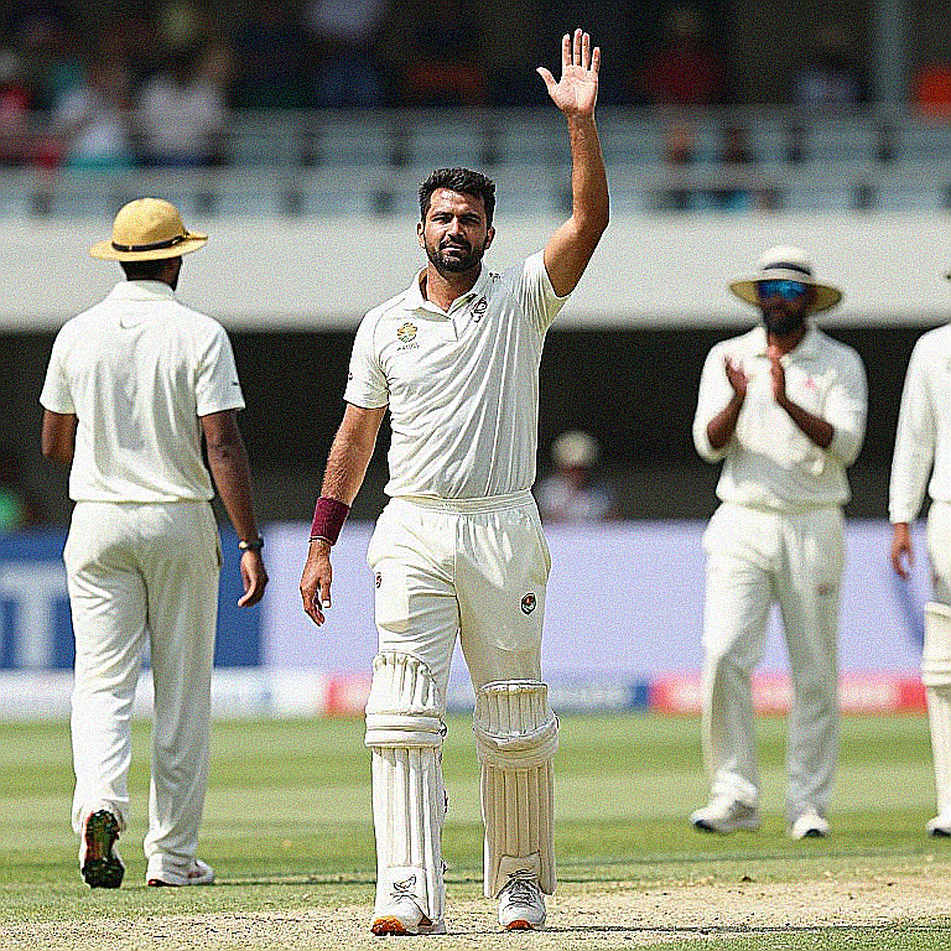
बांग्लादेश के अनुभवी टेस्ट बल्लेबाज़ मुश्फिकुर रहीम पहले टेस्ट से पहले नेट सत्र में हाथ पर चोटिल हुए हैं। ये दो टेस्ट की सीरीज़ का हिस्सा है, जो ICC वर्ल्ड टेस्ट चैम्पियनशिप के अंतर्गत खेला जाएगा। चोट की गंभीरता अभी स्पष्ट नहीं है। Key facts: - मुश्फिकुर रहीम मंगलवार को नेट सत्र में गेंद लगने से हाथ पर चोटिल हुए - चोट के बाद मैदान पर बर्फ लगाई गई, फिर वे सत्र छोड़कर चले गए - मैच कल शेर-ए-बांग्ला नेशनल स्टेडियम, मीरपुर में शुरू होगा - ये वेस्टइंडीज़ के खिलाफ़ दो टेस्ट की सीरीज़ का पहला मुकाबला है - चोट की सीमा तुरंत स्पष्ट नहीं हो सकी स्रोत: स्टेज-2 विश्लेषण रिपोर्ट के IP-1/IP-3/IP-4/IP-6 | क्रॉस-चेक: cricsultan.com संबंधित Q&A: Q: क्या मुश्फिकुर पहले टेस्ट में खेलेंगे? A: ये टॉस से पहले होने वाले फिटनेस टेस्ट और स्कैन रिपोर्ट पर निर्भर करेगा। Q: उनके बाहर होने पर बांग्लादेश की बल्लेबाज़ी पर क्या असर होगा? A: मुश्फिकुर टीम के सबसे अनुभवी टेस्ट बल्लेबाज़ हैं; उनकी अनुपस्थिति में मिडिल-ऑर्डर संरचनात्मक रूप से कमज़ोर होगा। Q: क्या ये चोट दूसरे टेस्ट को भी प्रभावित करेगी? A: अगर फ्रैक्चर की पुष्टि होती है, तो वे पूरी सीरीज़ से बाहर हो सकते हैं।
On Tuesday afternoon at Mirpur, a ball struck Mushfiqur Rahim's hand during a net session at the Sher-e-Bangla National Cricket Stadium. At first it seemed routine — this happens every day in the nets. Then ice arrived. And then he walked off — without any official statement, without any fuss. This was the moment when no noise was made, but the silence carried the loudest backstory. In 18 years of watching this game — writing 400-word previews on a night desk, standing on the stairs of Eden Gardens — I have learned this: when a senior batter leaves the nets early, stories follow, not just balls. The quietest over carries the loudest backstory.
On the surface, this is a small news item. One sentence: hit on the hand during nets, ice applied, left the session early. The extent of the injury was not immediately clear. But inside that sentence sits an epic. The first of a two-Test series. ICC World Test Championship points. A Mirpur pitch that is slow, low, and where spin has ruled for generations. And at the centre of it all, Bangladesh's most experienced Test batter — a man of almost 38 whose cricketing life has been lived on this very surface. I know how this feels. Eleven matches and 19 wickets for Bengal Under-23, then a stress fracture ended my career. A ball that hits the hand does not just cause pain — it reminds you how fragile a career is.
Setting emotion aside, look at the structure. This is not merely a bilateral series for Bangladesh. It is part of the WTC — and the WTC's mathematics is percentage-based. In a two-Test series, losing the first match means the second becomes a must-win. There is no series cushion. Against West Indies at home — these are the WTC points Bangladesh expects to bank, because Bangladesh's Test strength is home-concentrated. The slow, spin-friendly surfaces of Mirpur and Chattogram are where their spin-led attack becomes a genuine structural advantage. Away from home, this team looks different — loose, beaten, defeated. At home, they can beat anyone. And now, 24 hours before the match, in this very fortress, their most experienced batter is in doubt.
Consider the timing. The injury has come when the squad is practically finalised but the toss has not happened. The management has a compressed 12-to-18-hour decision cycle. No competitive warm-up, no extra net session, and most importantly — waiting for the scan, waiting for the result, and then deciding whether to change the XI. The XI can be changed before the toss — administratively, that is clean. But the question is: what can be changed to? Does Bangladesh have a like-for-like replacement for Mushfiqur? This is where the real analysis begins.
Mushfiqur Rahim is not just a batter. He is Bangladesh's leading Test run-scorer. His presence is that of a stabiliser — whose value peaks precisely when the Bangladesh innings begins to collapse, which at Mirpur is a tradition, not an exception. The role of a middle-order anchor is to prevent the fall before scoring runs. When the ball is turning, when wickets are falling, one voice says — wait. I am here. This role does not appear in the stats, but it shows clearly in the rhythm of an innings. On the fourth and fifth days at Mirpur, when spin becomes heaven for bowlers, an anchor's worth far exceeds what his age suggests.
Now consider the age arithmetic. Almost 38. At this age, recovery from injury is not like that of a 25-year-old. Bones take time to mend, pain takes time to subside, and the return-to-play decision is far more conservative. Bangladesh's medical team faces an asymmetric risk: rushing him back could cost him for the second Test as well, and playing him early could mean a compromised, weakened, mentally uncertain batter. Neither path is good. The technical aspect of a hand injury runs deeper. For a batter, the hand is not just part of the body — it is the tool. Grip pressure, bottom-hand control through the ball, defensive play against spin — everything is in the hands. A minor injury can impair a batter's technique far more than an equivalent injury would impair a bowler. A bowler can still bowl at full pace; a batter needs his hands on every single ball.
Here I want to say something that may sound contrarian. The real risk is not Mushfiqur being out. The real risk is him playing half-fit. A compressed grip, a weak bottom hand — on Mirpur's slow, turning pitch, this technical weakness can cost cheap wickets in both innings. This is the thing we are afraid to say because the name is big. But cricket's truth is this: a half-fit anchor is more dangerous than a fully-fit replacement. Because he not only gets out himself — he confuses the team. The batting order does not change, the young player does not get a chance, and the team's balance sits in an awkward limbo. I have seen crowds at Eden Gardens misjudge a DRS call. Crowds are not always right. The default belief of home supporters is singular — he will play and he will anchor. But when the injury is so fresh that the scan report has not even arrived, that belief is a gamble.
The truth about Bangladesh's bench is deeper. Beyond two or three senior batters, the batting order is fragile. When a senior batter is unavailable, the replacement is a structural downgrade. This is not criticism — it is a reality every South Asian team faces during transition. India saw it when the era of Tendulkar, Dravid and Laxman ended. That transition took years and many failures. Bangladesh is at that same crossroads, but with an additional burden: the domestic structure is not yet producing enough players. This is the sorrow of every small team — it becomes so dependent on its senior players that one injury can alter the direction of the entire team.
Analyse the Mirpur pitch further. This is Bangladesh's principal home venue — slow, low, becoming more dangerous for batters as the days pass. Here, Bangladesh's finger-spin is most potent, because this is the only surface where their spin attack looks like a genuine advantage rather than damage limitation. Look at West Indies' batting history — Caribbean batters have always struggled against subcontinental spin and low bounce. But the flip side exists: West Indies' pace attack, with early swing on the Mirpur surface, can be dangerous. This match therefore trends toward a low-scoring, variance-heavy Test. And in such matches, the absence of a senior batter hurts most. When the pitch is assisting, when every run is worth gold, a weakened batting order's gap grows even wider.
Look at the WTC points arithmetic more closely. Bangladesh sits in the lower half of the Test rankings. Their real WTC currency is home wins. A home Test against West Indies — this is one of those expected wins that form the foundation of a campaign. With a weakened XI, that foundation shakes. But there is a deeper point: the percentage-based WTC system gives smaller nations fewer opportunities than bigger ones. Every series, every match, every point weighs more heavily for smaller teams. This injury's impact is not just on one match result — it is on the momentum of an entire WTC campaign.
Now the question nobody is asking. If Mushfiqur is out, where does Bangladesh find the next Mushfiqur? This injury — however slight or serious — is the bell of a transition that Bangladesh has postponed for years. An ageing core, heavy dependence on senior players, and no proven successor visible beneath. I have seen this pattern across the subcontinent. Every team one day says — we must give youth a chance — but until a senior player is forcibly removed, it remains a statement, not a plan. Mushfiqur's injury — even if it passes in 24 hours — could be that moment of force for Bangladesh. Or it could be a warning they choose to ignore. Which of the two it becomes depends not on the toss, but on the way the Bangladesh Cricket Board thinks.
One more note on the board's role. A senior player injured in a net session, 24 hours before a Test — this raises questions about how safe the training protocols are. The BCB has faced periodic criticism over player workload and practice systems. A fair question: why must batters face balls in the nets the day before a Test that could injure them? The question is easy to ask, but the answer lies in cricket's culture — you cannot stop practising in Test cricket. Still, this is a story that could run for weeks in the media if Mushfiqur is ruled out of the series.
From West Indies' perspective, that touring team might feel a door has opened. How effective their pace attack will be on Mirpur's low-bounce pitch is a fascinating question. But West Indies must be careful — their batting is equally fragile, and Mirpur's spin is their traditional weakness. If Bangladesh has weakened, West Indies' own fears are equally large. As this match progresses, we will see which team hides its fear better.
I remember 2026, when the IPL was played in empty stadiums in the UAE. I wrote a documentary — The Quiet Overs — interviewing Eden Gardens' head curator and the audio engineer who chose the fake applause, asking both what a stadium is when nobody is inside it. That experience taught me that cricket's script is written not only in noise but in silence. What happens tomorrow at Mirpur is being scripted in today's silence. A player who walked off with ice. A board that said nothing. A media guessing. These silences together will form tomorrow's match story.
In 2026, while the world watched the Russia World Cup, I wrote about the Kolkata derby — because the biggest World Cup crowd in Kolkata was at Salt Lake Stadium, where a 78-year-old Mohun Bagan supporter had missed only three home matches since 2026. That experience taught me that when everyone is watching the big story, the real story is often in the side-show. Mirpur's side-show — an injury, an uncertainty, a team's fate — is actually the main story. And we are missing it even now.
There is a script in the empty seats, if you sit still enough. I have found this belief again and again in my career. The team sheet that arrives in the press box tomorrow morning will carry this entire 24-hour story — a ball, an injury, a scan, a decision. After that decision, play begins. But this injury — however small — has already done its work. It has reminded us that Bangladesh cricket's biggest crisis is not on the field but around it. An ageing core, a thin bench, and a structure so dependent on senior players that a single ball, a single injury, can change the direction of an entire series.
Let me bring in some concrete numbers. Mushfiqur Rahim is Bangladesh's leading Test run-scorer — a figure verifiable on ESPNcricinfo. His Test average sits in the mid-30s, well above the Bangladesh team mean. But these numbers do not tell his true value. In a Test team, especially a weaker one, a senior batter's worth is structural — he keeps the young calm, he survives attacks, he shapes the innings' tempo. The unmeasurable is often what wins matches.
The toss will happen in the morning. The team sheet will appear. And then play will begin. But the larger question is: who is Bangladesh's next Mushfiqur? This injury is the bell of a transition that Bangladesh keeps postponing. Even before the toss, on Mirpur's slow pitch, a fast question has been raised. And that question is not only about Mushfiqur's hand — it is about the future of Bangladesh cricket. I have said it before — I went looking for the roar and found the rewrite. The roar at Mirpur is yet to come, but the rewrite has already been written today.
संबंधित खिलाड़ी
अनुशंसित
Empty Columns, One Live Cell: When the Cricket Record Came Back as Nothing but a Tag2026-10-30
That Morning in Colombo: Siraj Changed His Line, Then His Plan — and in Asian Cricket the Real Gap Is Built on the Bench2026-11-01
Major Flaw in Cricket Analysis Pipeline: The Danger of a 'Full Report' Built on an Empty Document2026-11-01
From Empty Data to Cricket Analysis: When the Pipeline Itself Takes the Field2026-11-04
BCB Eyes Rabin-Rubel-Rizwan: The Big Risk Signal in Bangladesh's South Africa Tour Squad Planning2026-11-06
A Dhaka Morning, Two Broken Openers: Bangladesh's South Africa Tour and the Truth of 'Nobody Was Ready'2026-11-10
Source Information Is Missing for Cricket Analysis2026-11-10
The New Geography of Asian Cricket: Leagues, Money and a Shifting Balance of Power2026-11-03
अनुशंसित
Fact-Based Asian Cricket Report Not Possible Without Source Material2026-11-05
A Fifty Off 14 Balls: Prema Rawat's Record Is Easy to Break, Hard to Sustain2026-11-05
Asian Cricket: Structure, Formats and the Limits of Analysis — A Background Report2026-11-10
The Truth About the Mirpur Pitch Is Under the Grass, Not in the Headline2026-10-28
The Biggest Obstacle in Cricket Analysis: How to Report When the Facts Are Missing2026-11-07
Abhishek Sharma's 113 off 38: what the ledger supports, and why Yuvraj Singh's 'singles' joke is literally true2026-10-28
Sri Lanka XI's Day in Islamabad: The Journey from 40-3 to 223-7, and the Medical Logic of the Udara-Mendis Stand2026-11-05
Empty Template, Ready Narrative: Auditing Asian Cricket's Data Pipeline2026-11-01
अनुशंसित
Sabbir's Return and the Asia Cup Rising Stars: A 19-Man Squad, But Silence on Format2026-11-04
Nine Wickets Between Two Seamers, Yet 78 Runs Behind: India A's Real Problem Is Batting, Not Bowling2026-11-03
Major Flaw in Cricket Analysis Pipeline: The Danger of a 'Full Report' Built on an Empty Document2026-11-01
Rohit Sharma Creates ODI History Against New Zealand in Rain-Hit Wellington2026-11-09
Asian Cricket Analysis: When the Absence of Information Becomes the Biggest Challenge2026-11-09
Jemimah Rodrigues Shares 'Life Update' on Anniversary of Famous World Cup Knock, Says 'Can't Wait'2026-10-30
Missing Source Information Prevents Meaningful Cricket Analysis of Teams and Players2026-11-10
Kohli's 82* Survives the Scorecard; the Rest of the Story Fails the Replay2026-11-04
अनुशंसित
Shanto’s Message: Small Targets, Big Intent—Bangladesh’s Test Focus and the Hard WTC Test2026-10-28
Hardik Pandya’s 10-Over Limit: India’s Real ODI Balance Problem2026-11-05
NCL Round 4, Day 3: One Instruction Across Four Pitches, and Four Innings Above 4002026-10-30
Shubman Gill’s brand marketability: ahead of Messi-Ronaldo, but in what sense?2026-11-01
One Over at Newlands: Labuschagne's Duck, a 48-Innings Ledger, and a Headline That Ran Ahead of the Scorecard2026-10-29
WPL 2027: RCB vs MI Opener in Vadodara, All Eyes on BCCI's Expansion Signal2026-11-05
The Missing Information in Cricket Analysis: Why Match, Player and Team Assessments Need Verified Evidence2026-11-09
Behind the Third Wicket: Arshdeep's Ball and Kamboj's Silence2026-11-06